A new research project investigates thrips monitoring, movement, and environmental preferences.
Given market demands for unblemished, residue-free fruit, successful thrips management requires a strong grasp of the pest’s biology. However, the many unanswered questions about thrips in blueberries (and several other fruit crops) thwart effective control.
“Thrips are the pests that create the most headaches for South African blueberry growers,” says Theo Lombard, technical manager for blueberries at Core Fruit. “They can cause really serious economic damage during flowering and early fruit set.”
Additionally, infestations on new leaves can stunt growth and reduce yields. “It’s difficult to quantify that damage,” remarks Lombard. “But if populations are not suppressed during the vegetative period, they can spill over into the flowering period, reaching levels that can’t be controlled by spraying.”
To help growers better comprehend thrips, BerriesZA and SATI are jointly funding research on thrips in blueberries, table grapes, and the surrounding landscape. The four-year project (2026–2029) is led by applied entomologist Prof. Chris Weldon of the Department of Zoology and Entomology at the University of Pretoria.
Monitoring and thresholds
Monitoring is essential for integrated thrips management, yet we lack guidelines for best practices and economic thresholds in blueberries.
“There are many ways to count thrips, and not all growers use the same methods,” says Lombard. “If we understand how to monitor and count thrips, we can make more informed decisions about what and when to spray.”
For the new project, Weldon’s team will compare different monitoring methods (flower beating, leaf beating, ethanol washing, suction sampling, sticky traps, and emergence traps) across several sites.
The researchers will also be quantifying larval and adult thrips monthly for one season. They will sample several orchards and cultivars and relate thrips numbers to plant phenology, thrips egg-laying, and damage to flowers, fruit, and leaves.
Drawing on published methods, Weldon’s team will estimate thrips population sizes based on their samples. “If you know how many insects there are before and after you apply control, you can work out the effectiveness of the control method,” says Weldon.
With information on the effectiveness of control measures and on production costs, crop value, and the cost of control measures obtained from growers, the researchers can calculate economic injury levels (the threshold at which a particular intervention becomes worthwhile) using standard formulas.
“You need this information to estimate at what point you should use a control method,” says Weldon. “For example, if a control method is effective, but costly, you need to balance the cost and effect when using it.”
The neighbourhood effect
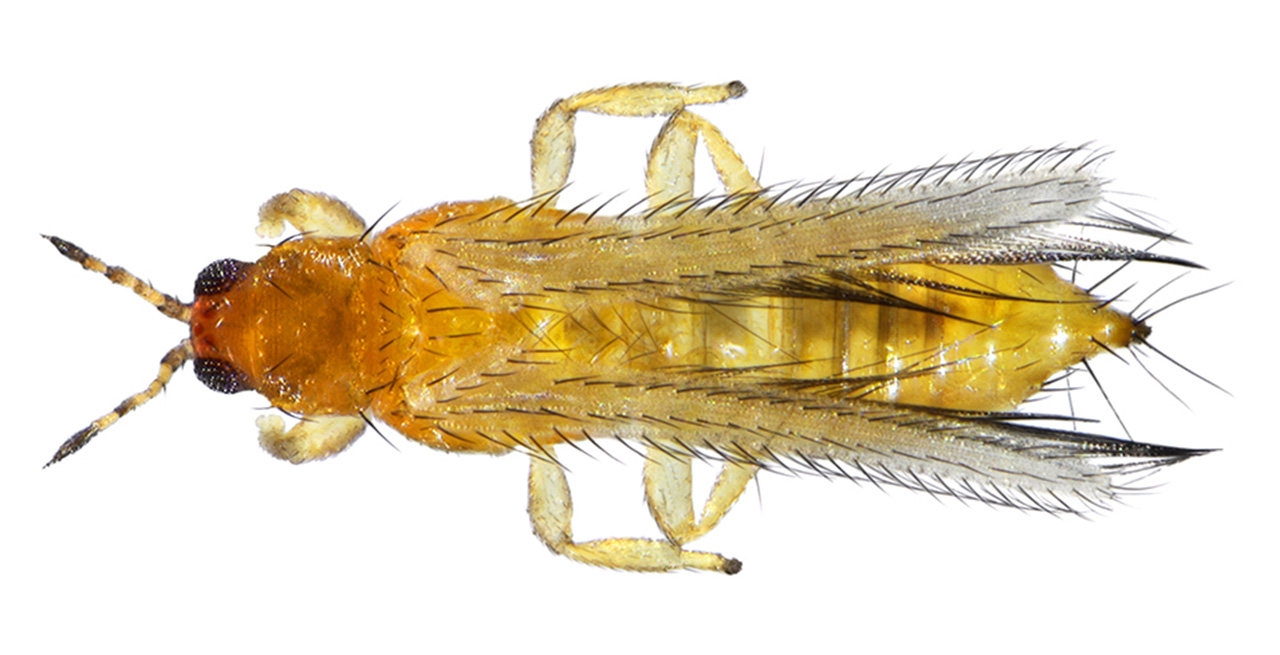
Western flower thrips (Frankliniella occidentalis)and South African citrus thrips (Scirtothrips aurantii), the main thrips pests on blueberries, feed and reproduce on a wide range of host plants, including natural vegetation and many fruit crops. As other plants surround blueberry orchards, growers need to know how these influence the risk of thrips damage.
“We must understand the environmental drivers of thrips populations,” says Lombard. “What environments do they prefer? Do they come into the orchard from outside? Or do they stay in the orchard, and we’re not controlling them with spray applications?”
To study thrips dynamics in complex landscapes, Weldon’s team will sample thrips and assess damage monthly for two seasons from multiple locations in the Western Cape, North West, and Limpopo Provinces. They will also compare thrips abundance between the edges and centres of blueberry orchards and relate this to the distance between blueberries and other hosts.
Thrips will be identified based on their appearance and genetics. The researchers will also use genetic markers to investigate thrips movement between crops. In previous research on thrips in avocadoes and macadamias, Weldon found genetic evidence that some thrips populations may be adapting to specific hosts.
“You could have avocado and macadamia plants growing side by side, but with populations of thrips that differ genetically,” he says. “We think the rapid introduction of those crops into the landscape led to a rapid expansion of genetic diversity among the thrips.”
Weldon speculates that part of this diversity reflects the preference of different thrips populations for certain crops, and that similar changes may be occurring in thrips in blueberries.
Model behaviour
Besides concerns about residues, chemical control of thrips is constrained by the lack of registered products and the limited number of applications allowed. Consequently, growers need to time each of the few permitted sprays for maximum impact.
Lombard points out that site and seasonal differences complicate thrips control. Farms are under variable infestation pressure, not only due to climate and microclimate but also to neighbouring vegetation and crops.
“We need to understand how to break the life cycle,” he says. “It’s not as simple as knowing thrips increase with warm, dry weather.”
Based on his previous research, Weldon suspects reproduction in the orchard accounts for a significant proportion (possibly most) of the thrips on avocadoes and macadamias. He also observed some exchange between neighbouring crops, with different crops more or less able to boost thrips populations.
“We were looking at population fluctuations and differences in abundance over time in different parts of the landscape,” he elaborates, “and then associating that with environmental conditions during thrips population peaks.”
In his project for BerriesZA and SATI, Weldon will model the environmental drivers of thrips abundance, enabling growers to discern when and where thrips are likely to invade their orchards and plan control measures accordingly.
“The model will focus on the environmental data that can be remotely sensed or measured on site,” says Weldon. “For example, we will be looking at blueberry phenology, what the nearest other crop is, and how far away it is.”
Additionally, he plans to include altitude, temperature, rainfall, NDVI and NDRE (remote-sensed measures of plant growth), and land-use diversity.
Cultivar preferences
For the final project objective, the researchers will collect leaves at vegetative bud break, flowers at full bloom, and fruit at the green stage from different blueberry cultivars. The team will analyse the samples for volatile compounds and nutritional content.
By correlating volatile compounds and nutritional content to thrips abundance, Weldon hopes to discover what attracts thrips to particular cultivars.
“We’ve heard from blueberry farmers that certain varieties are more prone to thrips damage, whether on the growth flush or during flowering,” says Weldon. “We want to find out what it is about the plant itself that makes it more likely to be attacked.”
Lombard anticipates that the new project will assist growers in mastering thrips. “This is the most common pest in blueberries, and the hardest to control, because there seem to be endless numbers of them,” he says. “Even experienced growers struggle to manage thrips.”