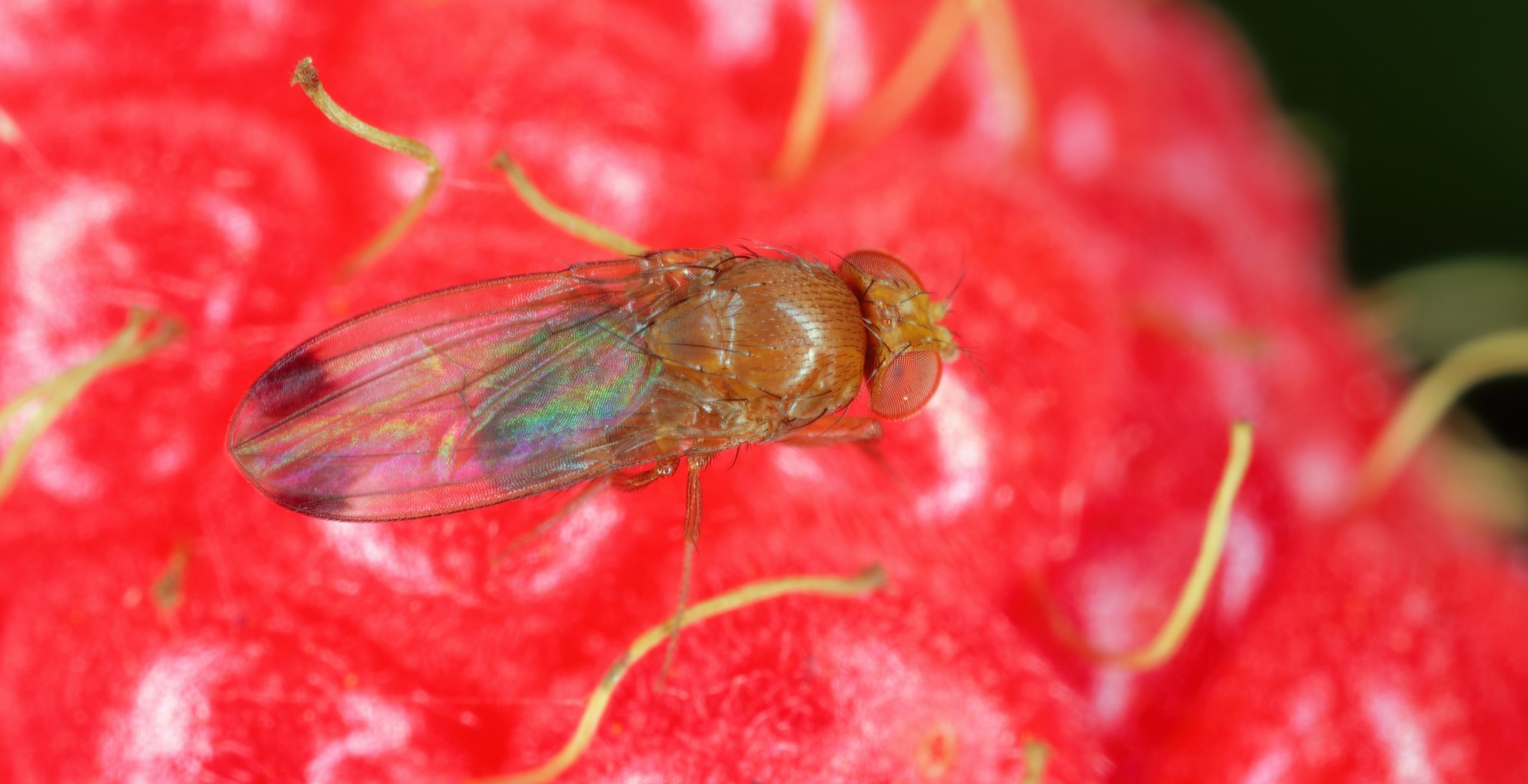
Start with the most effective interventions when building SWD management programmes.
There are only a few South African registrations for products against SWD (spotted wing drosophila), and market requirements further constrain chemical control. But full-cover insecticide sprays are, in any case, not a solution for SWD — this strategy has been tried in the United States, and they are already seeing resistance developing.
Medfly control relies on specific baits and lures, but their development for SWD is a work in progress. We don’t yet have SWD bait sprays or similar products. The available mass-trapping and attract-and-kill options are not standalone control measures but part of a range of interventions to help manage SWD.
These interventions include several unsexy but highly effective measures. And they all have the benefit of reducing not only SWD but also many other pests and diseases.
Shut down the buffet
Male and young female SWD feed on overripe and rotten fruit. The flies are attracted by volatiles released by fermentation. Once females have mated, they are attracted to volatiles released by fresh fruit and yeasts, because they lay their eggs in intact (even green) fruit.
The more ripe, overripe, and spoiled fruit are in the orchard, the more SWD males and females will pour in from all sides. The volatiles released by these fruit are like a neon sign advertising that the orchard is open for lunch. Once the flies arrive, they breed, and a steady stream of new flies emerges from fruit left on or under plants.
Not attracting, feeding, and breeding SWD is the single most impactful action growers can take to control these flies.
Orchard sanitation is crucial. Do not leave any overripe berries on the plants or the orchard floor. Harvest as early as possible and adhere to picking intervals.
One way to dispose of waste fruit is to put large plastic drums with lids throughout the orchard. Black drums are ideal. Workers can place the waste in the drums and clip the lids on. The heat and fermentation will kill fly eggs and larvae within a few days.
Waste can also be sealed in plastic bags and left in the sun. Alternatively, freezing works, as does burial, provided the material is immediately covered by at least 30 cm of soil.
Create the right culture
Cultural practices reduce SWD pressure by creating an unwelcoming environment. The flies like dark, humid conditions. They also do best at 16–25 °C and seek out cool microclimates during the warmest parts of hot days, even sheltering in vegetation near orchards.
Additionally, females lay more eggs on fruit in the centre of the canopy. They also prefer shaded sections at the bottom of the canopy to sun-exposed sections at the top. Maintaining open canopies and removing the lowest branches discourages egg-laying females.
Many SWD pupate outside fruit, and pupae are sensitive to heat and desiccation. Sunlight on a clean orchard floor reduces their survival compared to cover crops, weeds, or leaf litter. Research has shown that weed fabric also raises temperatures and lowers humidity, and can prevent larvae from reaching the soil to pupate.
Orchards can be made even more inhospitable by removing neighbouring food and shelter. SWD will lay eggs in almost any soft fruit and hang out in nearly any shady spot. Eliminating alternative hosts such as brambles and fruiting trees and shrubs pushes the flies to seek habitat farther away.
Lastly, cultivar choice affects SWD risk. Research on blueberries and other fruit types has demonstrated that SWD females prefer some cultivars, but the underlying reasons aren’t well understood. Although female flies generally seem to like thinner-skinned fruit and higher sugars, this isn’t always true.
BerriesZA is currently co-funding a project investigating the susceptibility of different cultivars. Meanwhile, some growers are replacing later with earlier cultivars, as SWD infestation pressure tends to escalate over the course of the season.
Traps and sprays
Directly killing flies should be the tip, not the base, of the SWD management pyramid. At the time of writing, there are three products registered for full-cover spray applications, and three for attract-and-kill and mass trapping. Growers must consult their crop-protection adviser about the best strategy for their situation and markets.
Monitoring is based on traps and fruit damage assessments. A demonstration of the flotation method for detecting SWD larvae in fruit is available on YouTube. Damage assessments are more accurate than trapping for identifying and quantifying infestations.
Traps must be in place before fruit begin to ripen. Traps positioned at the corners or on the perimeter of orchards can provide an early warning of invading flies. However, trap catches are not correlated to fruit damage.
Commercial wet and dry traps are available, and growers can also make their own, as demonstrated in this YouTube playlist. Dry traps require less frequent bait replacement, and the flies are easier to identify and count than in wet traps. Wet traps need to be sieved to collect the catch and the liquid replaced weekly.
Homemade and commercial traps are also used at 100–300 traps per hectare for mass trapping. Opinions differ on the efficacy, but everyone agrees that it’s labour-intensive.
One challenge with mass trapping is that female flies tend to prefer ripe fruit over the available lures. If growers want to implement mass trapping, they’re likely to have the best results by deploying the traps early in the season when traps don’t compete with ripening fruit, and when fly populations are low enough for the traps to have a real impact.
Mass traps must always contain a surfactant or a killing agent, otherwise, the traps become feeding stations. There have been instances where traps without killing agents or surfactants were associated with elevated fruit infestation.
Additionally, depending on the lure, SWD traps can be highly attractive to bees. Exclude bees by keeping the trap holes less than 3 mm in diameter.
If infestation levels justify full-cover applications, growers currently have recourse to spinosad or spinetoram applied 7–14 days apart for a maximum of three sprays. Apply sprays at dusk or dawn, when adult flies are most active.
Spinosad or spinetoram have the same mode of action, and their overuse has led to resistance in the United States.
Although spraying when the flies have already run riot is a form of damage control, its effectiveness is a distant second to preventing population explosions in the first place. Orchard sanitation, frequent picking, and cultural practices might sound like old news, but these measures are what move the needle on SWD control.
Read more
SWD fact sheet.
Best practices for SWD management. Includes more details on everything covered above.
The March 2025 issue of Fresh Quarterly, Hortgro Science’s technical magazine for growers, focuses on SWD and is available online.
Acknowledgements
Technical inputs were provided by:
Dr Francois Bekker. Technical Adviser and Research Manager. BerriesZA.
Henry Hays. Founder. Tzaneen Blueberries.
Hannes Steenkamp. General Manager. South Cape Fruit.
Dr Gideon van Zyl. Technical Adviser. ProCrop.