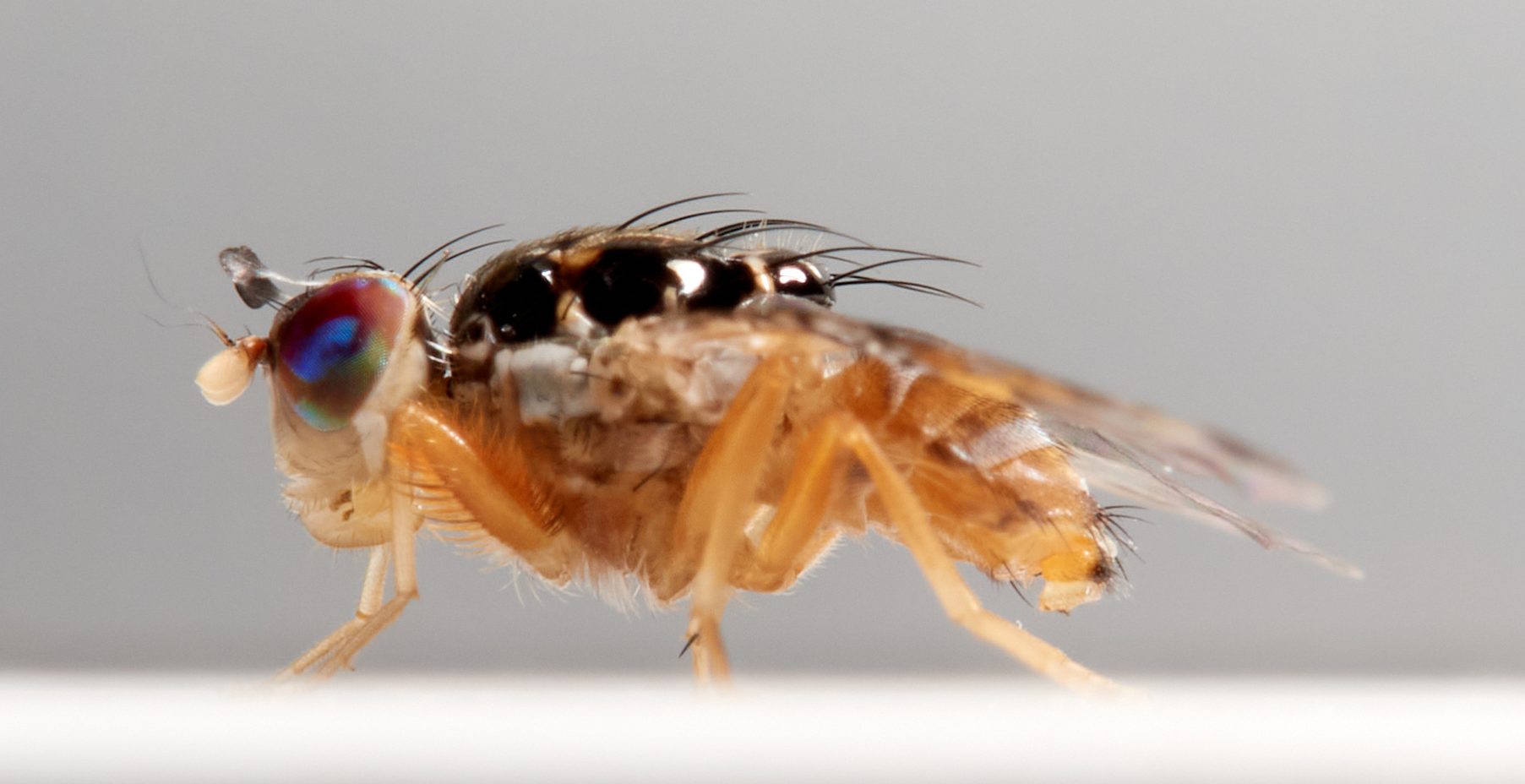
Medflies may not inspire the same dread as spotted wing drosophila, but growers need to keep a close eye on both pests.
Early damage on green blueberries at some sites during the past season highlighted how quickly Medflies take advantage of any deviation from best practices. Attending to the nine points below will provide sufficient protection in most seasons.
1. Get an early start
Baiting is most effective before fly populations surge, so initiate baiting based on trap catches, not your calendar. In seasons when fly reproduction ramps up early, missing the window of opportunity for control will result in damage.
Begin monitoring in orchards when the first flowers are present. Keep in mind that Medflies can lay eggs in berries as soon as the colour break starts. Yellow delta traps with trimedlure targeting males provide advance warning as increases in male Medflies precede increases in females.
2. Place traps correctly
Hang one trap per two hectares, preferably in a shaded position. The trap spines should align with the row direction. It should be easy for flies to enter the traps, so ensure branches or leaves don’t block the openings and that the traps are securely attached.
Out of season, move traps to habitats with potential food sources such as alternative host plants or bird droppings. Apply bait sprays or attract-and-kill products when flies are detected in these habitats.
3. Bait by numbers
Record trap catches weekly. Do not fall behind, as Medfly populations can escalate to damaging levels within as little as a week under favourable conditions. Females lay roughly 20 eggs daily, reaching a lifetime total of 300–800. The flies complete their life cycle in 3–4 weeks at temperatures of 25–28 °C.
Commence bait sprays in any orchard where flies are caught. If a trap catches one fly per week, bait the orchard every 14 days. If a trap catches two flies per week, bait it every seven days. Once catches exceed two flies per week, baiting twice per week is required.
If four or more flies are trapped per week, damage is likely, and additional measures, such as attract-and-kill systems, are needed. Full-cover spray applications during the production season are not an option in blueberries.
The figures above apply to traps with 1 g trimedlure capsules. Traps with lower dose trimedlure capsules are less sensitive.
4. Consider the climate
Bait early in the morning for the best results. Breakfast is a female Medfly’s main meal, so make sure she wakes up to fresh bait. Bait droplets also dry more slowly under cool conditions. Dried droplets are ineffective because they no longer release volatile attractants.
Do not bait in the 24 hours before rain. Repeat the bait application if it rains more than 10 mm after spraying.
5. Bait every bush
Every blueberry plant in the orchard must receive bait droplets. Patchy bait applications are associated with fruit damage. Adequate coverage is achieved by spraying every second row. Alternate rows between applications.
Rows that are narrower than 1.8 m don’t accommodate spray rigs. These orchards must be sprayed by hand or by drone. Keep in mind that mercaptothion is not registered for aerial application.
When spraying from the ground, apply the bait in a thin stream, aiming it at the underside of leaves. Drops on the underside are effective for longer because they dry more slowly.
6. Take care with calibration
The ideal droplet size for protein hydrolysate and mercaptothion is 1–3 mm. The ideal for GF-120 and similar spinosad-based products is 1–4 mm. Smaller droplets dry too fast, and larger droplets tend to run off, may cause phytotoxicity, and can contribute to sooty mould.
Using spinosad-based products before harvest and protein hydrolysate and mercaptothion after harvest helps slow the development of resistance. Ensure that spray applications are recalibrated when switching between products, as they require different doses and water volumes.
Protein hydrolysate must be applied at a minimum dose of 1 litre per hectare to attract flies sufficiently.
7. Keep it fresh
Some products, especially spinosad-based formulations, tend to precipitate. Most tanks for bait sprays don’t have stirring or mixing systems, so mix these products thoroughly with a smaller water volume before adding the mixture to the tank. Use all the tank mix on the day it was prepared.
Never let tanks of spray mixes stand overnight. Once mixed, the bait sprays begin breaking down and lose effectiveness.
8. Don’t feed flies
Talk to any fruit-fly expert, and the conversation soon turns to alternative hosts. A vast host range is one reason why Medflies are such a widespread invasive pest. Females lay eggs in almost any fruit and eagerly exploit home gardens and wild vegetation.
Remove alternative hosts if possible. If not, include them in monitoring, bait applications, or other control interventions.
9. Grow fruit, not flies
Orchard sanitation is crucial for controlling not only Medflies but also spotted wing drosophila. Good sanitation also reduces the spores of decay-causing fungi such as botrytis.
During harvesting, weekly removal of fallen and unharvested fruit is insufficient, as adult Medflies continue to emerge from infested fruit. Strip orchards and remove waste fruit immediately after picking.
Waste fruit can be buried, provided it’s covered on the same day with at least 30 cm of soil. The waste can also be placed in black drums with lids or in plastic bags and left in the sun. Alternatively, it can be frozen.
Acknowledgement
Thanks to Dr Gideon van Zyl for sharing ProCrop’s guidelines for successful Medfly management.