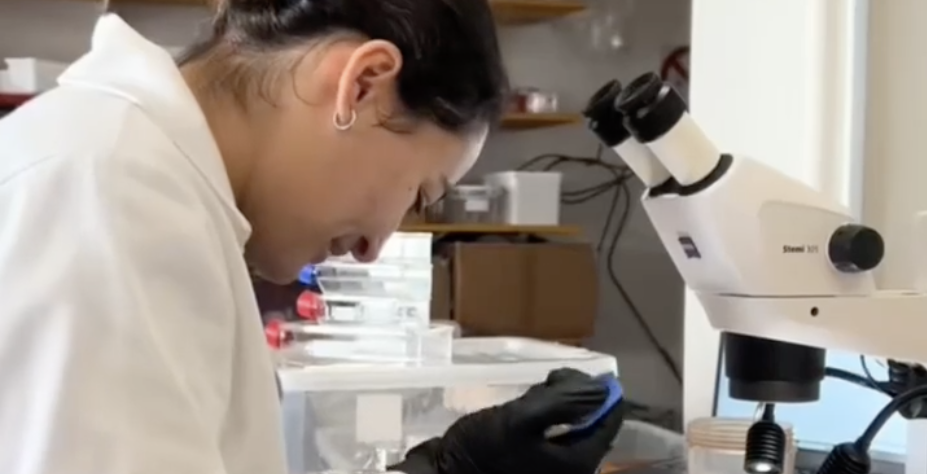
Catch up with three students involved in ongoing projects to develop a risk-management system and to inform integrated pest management for SWD (spotted wing drosophila).
The projects are led by Prof. Pia Addison of the Department of Conservation Ecology and Entomology at Stellenbosch University and co-funded by BerriesZA, Hortgro, SATI, and SAWine.
InsectScience, a South African crop-protection company specialising in the development of attractants and pheromones, is collaborating with the researchers, as specific and effective attractants for managing SWD are urgently needed.
Among other attractants, Chloe Meck is testing a yeast, Hanseniaspora uvarum. H. uvarum has potential as a lure for monitoring, mass-trapping and attract-and-kill applications. Learn more about her landing experiments in this video.

Lisa Kleyn has been running no-choice experiments to assess whether SWD is more successful on particular cultivars and fruit maturities. So far, some cultivars appear more susceptible to attack, but tests are ongoing.
Watch how Kleyn evaluates green, red, and fully ripe blueberries of different cultivars in this video.

Andrea Bennett is searching for natural parasitoids and predators of SWD. This work has already yielded a parasitoid, which the research team is currently trying to breed in captivity.
Bennett is also testing the effect of entomopathogenic nematodes against SWD. She has shared a great video with close-ups of developing SWD.
Additional information on the multi-industry project is available in the March 2025 issue of Fresh Quarterly, a free technical publication from Hortgro Science.
*
In a separate project, BerriesZA is funding a study on postharvest mitigation of SWD, led by Dr Renate Smit of the specialist postharvest research facility PHYLA.
Smit is testing ethyl formate and nitric oxide fumigation, which show promise for controlling SWD without adversely affecting fruit quality. However, these results are preliminary, and the research continues.